
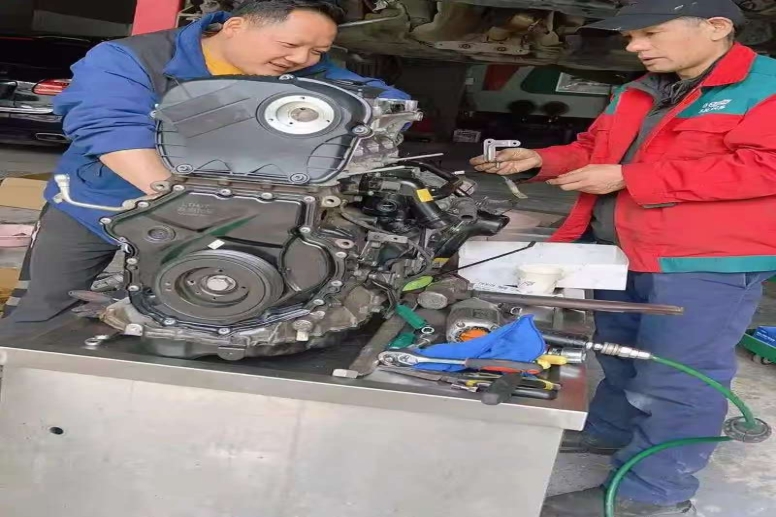
How do the main components of the engine fuel system work ?
The fuel system's primary job is to store, deliver, and prepare the correct mixture of fuel and air for the engine's cylinders to burn, across all operating conditions.
While designs differ (carbureted vs. fuel-injected, gasoline vs. diesel), the core components and their functions are conceptually similar. Here, we'll focus on a modern electronic fuel-injected gasoline engine, which is the most common today.
Main Components & Their Functions
The system can be divided into two sides: the low-pressure side (from tank to engine) and the high-pressure side (on the engine).
1. Low-Pressure Side (Delivery)
Fuel Tank: Stores the vehicle's fuel. It includes a Fuel Pump Module/Sending Unit, which houses the in-tank pump and a fuel level sensor.
Fuel Pump (In-Tank): An electric pump submerged in the tank. It pumps fuel at relatively low pressure (typically 30-80 psi) towards the engine. Being submerged keeps it cool and prevents vapor lock.
Fuel Filter: Removes dirt, rust, and other contaminants from the fuel before it reaches the critical injectors. It's usually located along the fuel line under the vehicle or in the engine bay.
Fuel Lines (Supply & Return): Metal or reinforced rubber hoses that transport fuel.
The supply line carries pressurized fuel from the tank to the engine.
The return line (not present in all systems—see "returnless" below) carries excess, unused fuel back to the tank to maintain pressure and cool the system.
2. High-Pressure Side (Injection & Control)
Fuel Rail: A hollow metal manifold that distributes pressurized fuel to each fuel injector.
Fuel Injectors: Electrically operated valves. When the Engine Control Unit (ECU) sends a precisely timed pulse of electricity, the injector opens and sprays a fine, atomized mist of fuel directly into the intake manifold (port injection) or the combustion chamber (direct injection).
Fuel Pressure Regulator: Maintains a constant fuel pressure at the injectors.
In older return-style systems, it's mounted on the fuel rail and bleeds excess fuel back to the tank.
In modern returnless systems, the ECU controls the pump speed to regulate pressure, and the regulator is often part of the in-tank module.
Engine Control Unit (ECU) / Powertrain Control Module (PCM): The "brain." It receives data from numerous sensors (throttle position, oxygen sensor, mass airflow, engine temperature, etc.) and calculates exactly how much fuel to inject and when to inject it for optimal power, efficiency, and emissions.
How They Work Together: The Process
Startup: When you turn the key to "ON," the ECU primes the system by powering the fuel pump for a few seconds to build pressure in the fuel rail.
Sensing Demand: As you start the engine and press the accelerator, sensors tell the ECU about:
Engine Load (Mass Air Flow or Manifold Absolute Pressure sensor)
Throttle Position
Engine Speed (Crankshaft Position sensor)
Engine Temperature
Oxygen Content in the exhaust (O2 sensor)
Calculation & Command: The ECU processes this data in milliseconds. Using pre-programmed maps ("look-up tables"), it determines the ideal air-fuel ratio (typically 14.7:1 for cruising, richer for power, leaner for economy). It then calculates the precise pulse width—how long to hold each injector open.
Delivery & Atomization: The ECU triggers the fuel injectors. Pressurized fuel from the fuel rail is sprayed in a fine mist into the intake path, mixing with the incoming air. For direct injection engines, fuel is sprayed at very high pressure directly into the cylinder.
Combustion: This air-fuel mixture is drawn into the cylinder, compressed, and ignited by the spark plug. The resulting explosion powers the engine.
Regulation & Return: The fuel pressure regulator ensures pressure remains constant so the ECU's injector pulse calculations are accurate. Any excess fuel is either circulated back to the tank (return-style) or the pump speed is adjusted (returnless).
Feedback Loop: The oxygen sensors in the exhaust continuously monitor the results of combustion. They send data back to the ECU, which makes tiny, real-time adjustments to the injector pulse (fuel trim) to maintain perfect efficiency. This is the closed-loop operation.
Key Variations
Diesel Engines: Use a mechanical or ultra-high-pressure electronic pump (up to 30,000+ psi) to inject fuel directly into the cylinder. The heat of compressed air ignites the fuel (no spark plug).
Carbureted Systems (Older): Rely on vacuum created by the engine to draw fuel from the tank via a mechanical pump and mix it with air in the carburetor before sending it to the cylinders. No electronic control.
Direct Injection (DI) vs. Port Injection (PFI): DI injects fuel straight into the cylinder at very high pressure for efficiency and power. PFI injects into the intake port, which is simpler and helps keep intake valves clean. Many modern engines use both (dual injection).
Summary Table of Components & Roles
| Component | Primary Function |
|---|---|
| Fuel Tank | Stores fuel. |
| Fuel Pump | Creates pressure to move fuel from tank to engine. |
| Fuel Filter | Cleans fuel to protect injectors and engine. |
| Fuel Lines | Pathways for fuel to travel. |
| Fuel Rail | Distributes pressurized fuel to all injectors. |
| Fuel Injector | Electrically controlled valve that sprays atomized fuel. |
| Pressure Regulator | Maintains constant fuel system pressure. |
| Engine Control Unit (ECU) | The computer that controls injector timing and pulse based on sensor data. |
In essence, the fuel system has evolved from a simple, passive mechanical device to a precisely managed, computer-controlled component that is critical to an engine's performance, fuel economy, and emissions output.