


Why Injection Pressure Matters: The Technology Behind 1500–2500 Bar in Modern Diesel Injectors
Introduction: The Hidden Force Under Your Hood
If you’ve ever looked at a diesel engine specification sheet, you’ve probably seen the numbers: 1500 bar, 1800 bar, 2200 bar, even 2500 bar. These aren’t just marketing figures – they represent one of the most advanced engineering feats in modern internal combustion.
But why does injection pressure matter so much? And what really happens when fuel is squeezed to over 36,000 psi (2500 bar)?
In this post, we break down the physics, the benefits, and the component-level technology that makes ultra-high-pressure injection the backbone of Euro 6, Tier 4, and future-ready diesel engines.
1. Atomisation: The Core Reason for High Pressure
The primary job of an injector is not just to “spray” fuel – it’s to atomise it into a fine mist with droplets as small as 1–5 microns.
At 1500 bar, fuel exits the nozzle at near-sonic speed (~500 m/s).
At 2500 bar, that speed exceeds 600 m/s, and droplet size shrinks by up to 30%.
Why this matters:
Smaller droplets = larger surface area = faster and more complete mixing with air. This leads to:
Higher thermal efficiency (more work from each drop of fuel)
Lower particulate matter (soot) – because combustion happens more homogeneously
Better cold-start performance
In short: pressure is the enabler of clean, powerful combustion.
2. Injection Timing and Rate-Shaping – Precision at 2000+ bar
Modern common rail systems don’t just deliver a single squirt. They perform multiple pilot, main, and post injections per cycle – sometimes up to 8 events per stroke.
At 2500 bar, the injector’s solenoid or piezoelectric actuator must open and close in microseconds while resisting hydraulic forces that could exceed 2 tonnes on the needle.
This is where hydraulic balance and nozzle geometry become critical. A 5% variation in pressure can shift injection timing by over 1° crank angle – enough to increase NOx by 10% or reduce torque by 3%.
That’s why OEMs and aftermarket specialists like Rsolid Engine Parts calibrate every injector to within ±1.5% of nominal pressure.
3. The 1500–2500 Bar Spectrum – Which One Do You Need?
| Pressure Range | Typical Application | Key Benefit |
|---|---|---|
| 1500–1800 bar | Older Euro 5 / off-road | Reliable, lower cost |
| 1800–2200 bar | Euro 6 on-highway | Best balance of NOx/soot |
| 2200–2500 bar | High-output trucks & marine | Max power density + lowest PM |
Higher is not always better – beyond 2500 bar, parasitic pumping losses increase, and component wear accelerates without proportional gains. The “sweet spot” for most heavy-duty applications is 2000–2200 bar, while performance tuning may push to 2500 bar with upgraded metallurgy.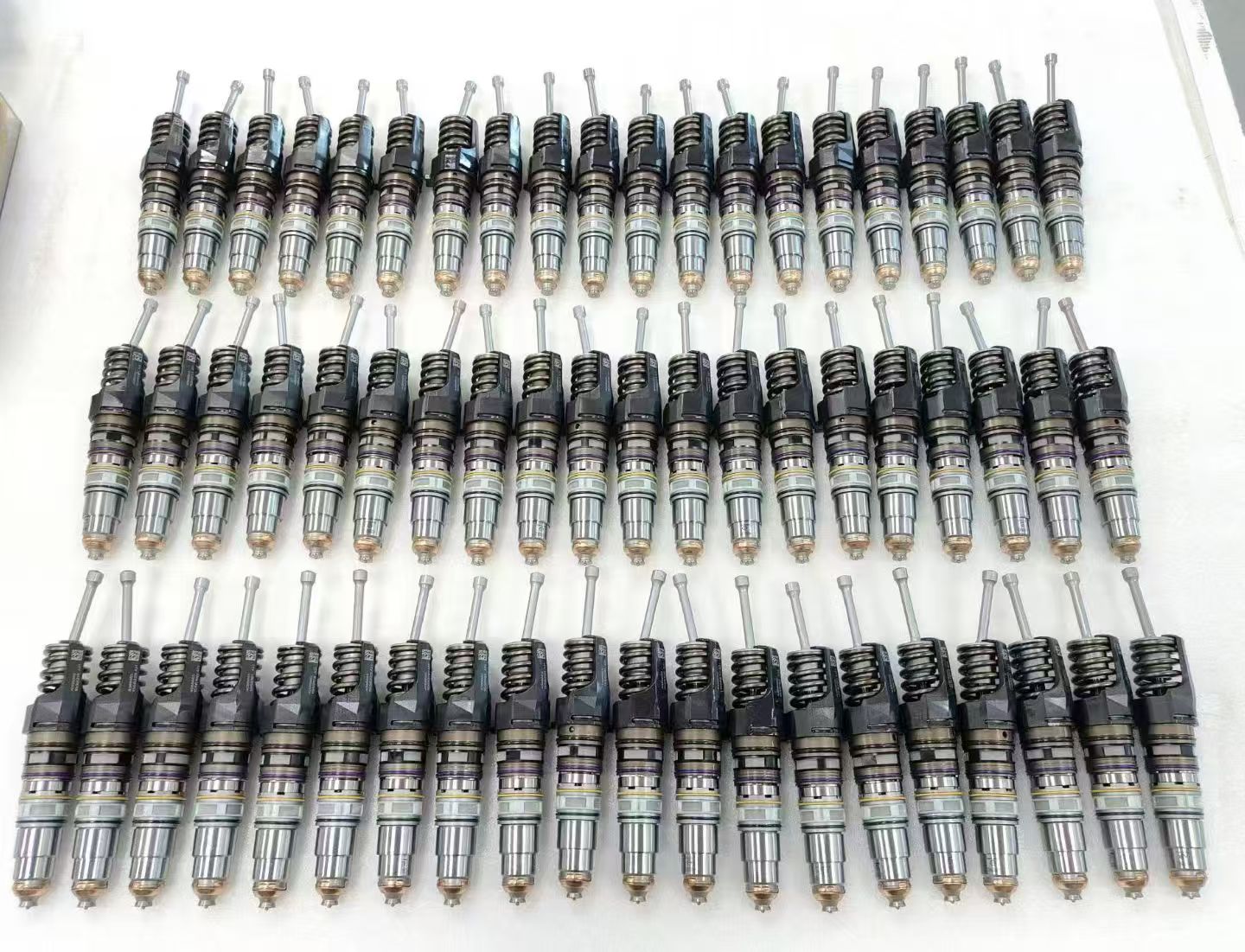
4. The Technology That Withstands 2500 Bar
Holding 2500 bar inside a tiny injector body (often < 50 mm diameter) requires:
High-strength martensitic stainless steel with yield strength > 1200 MPa
DLC (diamond-like carbon) coatings on plungers and needles to reduce friction and galling
Precision-ground control orifices – tolerances down to ±2 microns
Leak-free sealing using conical seat geometries and controlled torque
At Rsolid, every injector undergoes 100% high-pressure function testing on a Bosch EPS 815 test bench – simulating real engine conditions up to 2600 bar – before it leaves the factory.
5. Real-World Consequences of Insufficient Pressure
What happens if your injector pressure drops by just 10%?
Power loss: Up to 8–12% at rated speed
Smoke increase: Visible black soot under load
Fuel consumption: +5–7% due to incomplete combustion
DPF/SCR clogging: Faster ash and soot loading
Many drivers mistake these symptoms for turbo or sensor issues, but the root cause is often a worn injector plunger, sticking control valve, or eroded nozzle holes – all of which reduce effective injection pressure.
6. Why Aftermarket Quality Matters – The Rsolid Difference
Not all injectors labelled “2500 bar” actually deliver it. Cheap aftermarket units often:
Use lower-grade steel that deforms under heat
Skip the final flow-matching process
Have inconsistent spring preload
Rsolid Engine Parts takes a different approach:
OE-spec materials from German and Japanese suppliers
Flow-matched sets – all injectors in a set are balanced to within ±2%
Full documentation with test reports showing pressure, return flow, and actuation response
12-month warranty against manufacturing defects
7. Maintenance Tips to Preserve Injection Pressure
To keep your injectors performing at 1500–2500 bar for the longest time:
Change fuel filters every 500 hours – water and particulates are the #1 killers of plunger pairs.
Use high-cetane, low-sulfur fuel – lubricity additives protect moving parts.
Avoid excessive idle – low pressure at idle can cause carbon build-up on nozzle tips.
Test injector return flow annually – an increase of > 20% indicates internal leakage.
Conclusion: Pressure Is Power – But Only If It’s Controlled
The jump from 1500 to 2500 bar isn’t just a number – it represents decades of tribology, fluid dynamics, and control engineering. When maintained correctly, high-pressure injection gives you more torque, less smoke, and better fuel economy across the entire operating range.
If you’re sourcing replacement injectors or need expert advice on pressure calibration, Rsolid Engine Parts delivers OE-quality performance at competitive lead times.
📩 Get in Touch
Email: amy@rinjector.com
WhatsApp: +86 15975376778
Website: www.rinjector.com