


How to Spot Fake vs Genuine Bosch Diesel Injectors: A Complete Buyer’s Guide
Counterfeit Bosch diesel injectors are flooding the market. Learn 10 proven ways to identify fake injectors, protect your engine, and save thousands in repairs. Expert tips inside.
Introduction: Why Fake Bosch Injectors Are a Growing Threat
Bosch is the gold standard for diesel fuel injection systems. Their injectors power millions of trucks, tractors, and passenger vehicles worldwide. But where there’s demand, there’s deception. The global market for counterfeit automotive parts is estimated at over $50 billion annually, and diesel injectors are a prime target.
Why? A single fake injector can:
Reduce fuel efficiency by 10–20%
Cause rough idling, misfires, and white/black smoke
Damage your DPF, EGR, or even the entire engine
Void your warranty and lead to repair bills exceeding $5,000
This guide gives you actionable, photo-supported (mentally) methods to distinguish genuine Bosch diesel injectors from clever fakes—before you install them.
1. Start with the Packaging – The First Red Flag
Genuine Bosch injectors come in sealed, high-quality cardboard boxes with a distinct matte finish. Counterfeiters often cut corners here.
| Check | Genuine | Fake |
|---|---|---|
| Box color | Deep blue with crisp white Bosch logo | Washed-out blue, blurry print |
| Inner foam | Dense, custom-cut EVA foam holding the injector snugly | Cheap polystyrene or loose bubble wrap |
| Seal | Clear, tamper-evident tape with “Bosch” watermark | Plain tape or no seal at all |
| Batch number | Laser-printed on the box flap, matches the injector | Missing, mismatched, or ink-jetted |
Pro tip: Scan the QR code on the box with the Bosch Authenticity Check app (available on iOS/Android). Genuine codes lead to a unique product page; fakes either show an error or a generic Bosch homepage.
2. Decode the Part Number – The 12‑Digit Rule
Every genuine Bosch diesel injector has a 12‑digit alphanumeric part number (e.g., 0 445 110 586). This number must match:
The box label
The injector body (laser-engraved)
The vehicle’s original specification (check your VIN or owner’s manual)
Common fake tactics:
Using a valid number copied from a genuine unit – but the font or spacing is off.
Adding/removing a digit – e.g., 0 445 110 58 (short) or 0 445 110 5867 (extra digit).
Action: Cross-reference the number on Bosch’s official replacement parts catalog or call an authorized distributor. If the number isn’t listed, it’s 100% counterfeit.
3. The Laser Engraving Test – Font, Depth, and Alignment
Bosch uses industrial-grade fiber lasers for engraving. This produces:
Sharp, non‑removable characters with a subtle greyish-white hue
Even spacing and consistent depth (about 0.1 mm)
Slight tactile feel – run your fingernail over it; you’ll feel micro‑grooves
Fakes often use cheap ink-jet printing or low-power diode lasers. Signs:
Characters are black or dark grey (ink)
Smudge when rubbed with acetone or brake cleaner
Irregular spacing – e.g., “0 445 110 586” becomes “0 445110 586”
Visible burrs or melted edges around the letters
Quick field test: Dab a cotton swab with isopropyl alcohol and rub the engraving. Genuine laser marks are permanent; ink will smear within seconds.
4. Inspect the Solenoid Valve (Top Cap) – The Telltale Sign
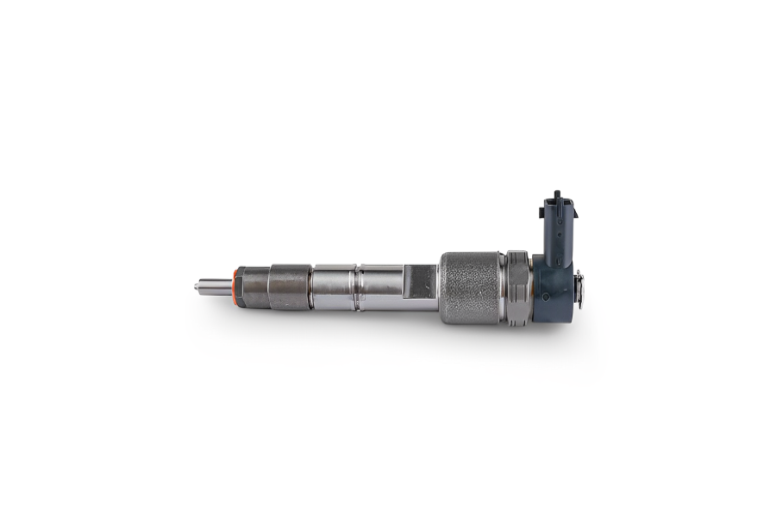
The solenoid valve (the metallic “bell” at the top) is a precision component. Genuine Bosch units have:
A perfectly flat, mirror-polished top surface – no scratches, pits, or tool marks.
Two tiny vent holes (diameter ~0.5 mm) drilled at exact 180° positions.
A copper washer that is seamlessly integrated, not loose or wobbling.
The Bosch logo laser‑etched on the side of the solenoid, not just on the body.
Fakes often use recycled or generic solenoids:
The top shows circular grinding marks.
Vent holes are missing, poorly placed, or too large.
The solenoid feels lighter – genuine ones weigh about 180–200g; fakes are often 10–20g lighter due to cheaper alloys.
5. Needle Lift Sensor (If Equipped) – The Hidden Clue
Modern Bosch injectors (e.g., CRIN series) include a needle lift sensor with a tiny electrical connector. Genuine sensors have:
A gold-plated pin inside the connector (corrosion-resistant)
A rubber O‑ring that is flexible and bright orange/blue
A clear laser‑marked “NLS” code near the connector base
Counterfeit sensors:
Use brass or tin‑plated pins (dull yellow)
Have hard, black O‑rings that crack easily
Lack the NLS code or have it printed in a different font
Important: If your vehicle requires a sensor and the injector doesn’t have one – or has one that looks cheap – it’s almost certainly fake.
6. The Nozzle Tip – Geometry and Hole Count
The nozzle is the heart of the injector. Bosch manufactures nozzles with micro‑drilled holes using EDM (electrical discharge machining) – tolerances down to ±2 microns.
How to verify (without a microscope):
Count the spray holes (usually 5, 6, or 7). Genuine holes are perfectly round, evenly spaced, and have a slight countersink.
Shine a bright light through the inlet; you should see clean, circular light dots.
The nozzle nut (the hexagon part) has two flat milled faces – not four or six.
Fakes often have:
Irregular hole sizes – some look oval or blocked
Burrs around the holes (felt with a needle)
A generic nut with no flat faces or rough machining
Advanced check: Use a magnifying glass (10x). Genuine Bosch nozzles have the Bosch name and “DE” (Germany) stamped on the side of the nut – it’s tiny but legible. Fakes omit this or use “BOSCH” in a larger, clumsy font.